What is a sintered stone?
What are the advantages and disadvantages of sintered stone and natural marble?
SINTERED STONE, is made of natural raw materials through a special process, with the help of more than 10,000 tons of presses, combined with advanced production technology, through the high temperature of more than 1200 ℃ firing, can withstand the cutting, drilling, sanding and other processing of oversized decorative panels.
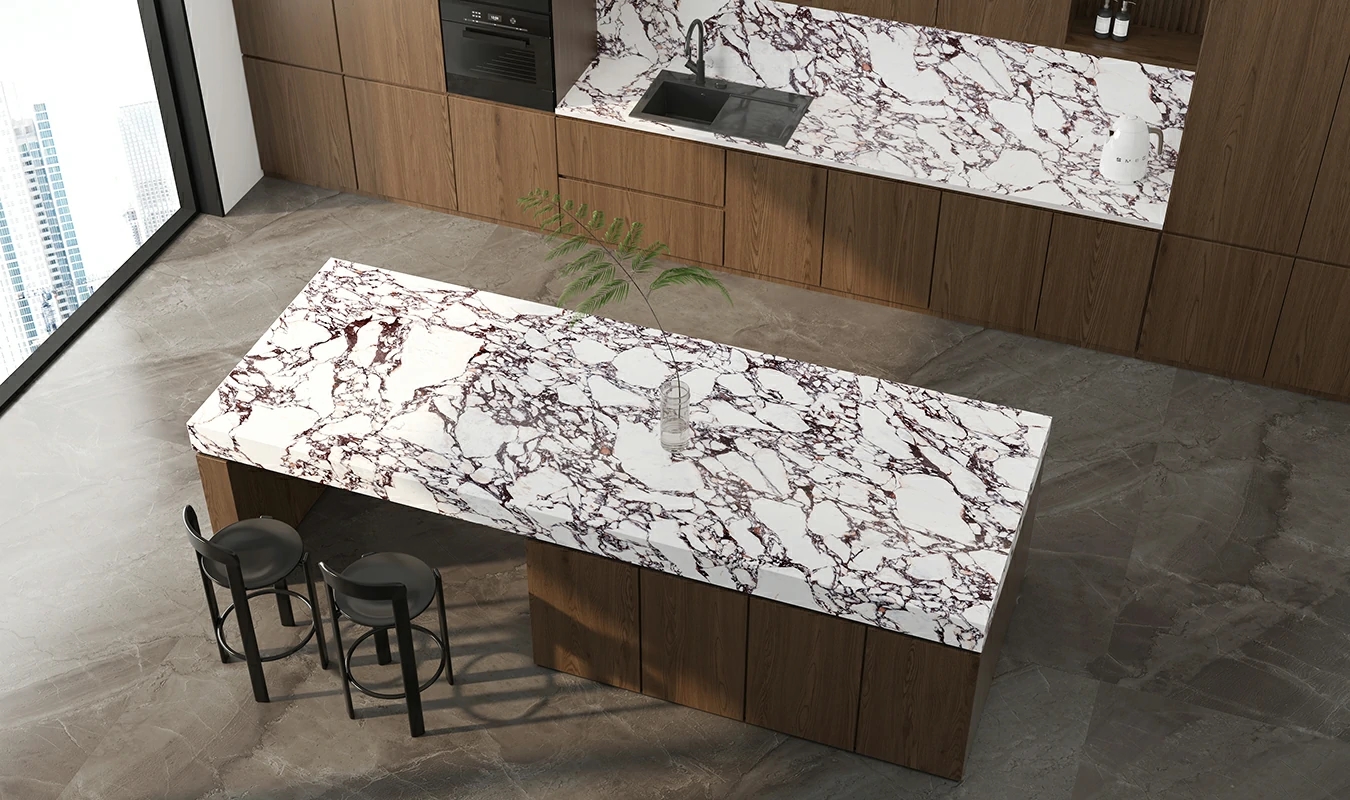
Calacatta Viola
Sintered Stone Kitchen Countertops
Advantages of sintered stone:
1. Sintered stone ultra-thin models, only 1/3 of the traditional ceramic tile, rock plate is even lighter, even less than 1/3 of the traditional ceramic tile, traditional ceramic tile average weight of 23-27kg / ㎡, while the average weight of ultra-thin rock plate is only 7kg / ㎡, easy to transport, installation.
2. The Mohs hardness of the sintered stone is as high as 7, and natural stone or ordinary quartzite, wood panels, compared with ultra-thin and lightweight, large specifications, strong moldability, colorful and diverse, stain-resistant and durable, fire-resistant and heat-resistant, zero-formaldehyde, green, construction and simple advantages. Nowadays, it is mostly used in home decoration for background wall decoration, cabinet countertop, desktop and so on.
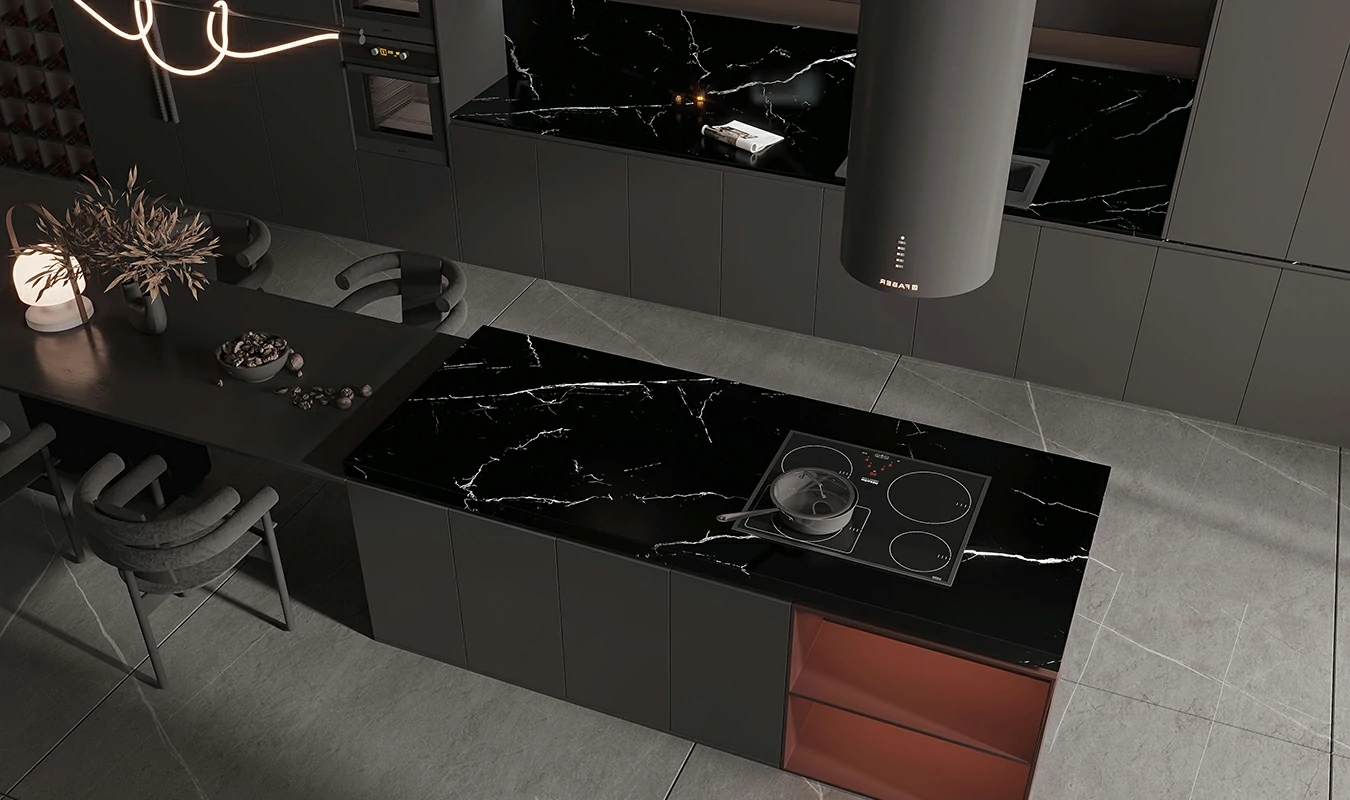
Carmen Black
Porcelain slab worktopsWhat is natural marble?
The formation of natural marble is a long process. Natural marble is a metamorphic rock formed by high temperature and high pressure in the earth's crust. It is a medium hard stone, mainly composed of calcite, limestone, serpentine and dolomite. Its main component is calcium carbonate-based, accounting for about 50% or more. There are many components of natural marble. Others are magnesium carbonate, calcium oxide, manganese oxide and silica.
Advantages of natural marble:
1. Natural marble is dense but not very hard, easy to process, carving and smoothing, polishing and so on. Marble polished smooth and delicate, natural and smooth texture, has a high degree of decorative. Marble water absorption rate is small, high durability, very wear-resistant, can be used for 40-100 years.
2. Natural marble has a fine texture organization, solid, polished and clean as a mirror, texture more than granite stretch, beautiful. Higher compressive strength.
Disadvantages of natural marble:
1. As marble generally contain impurities, and calcium carbonate in the atmosphere by carbon dioxide, carbide, water vapor, but also easy to weathering and dissolution, and make the surface quickly lose luster, generally only used for indoor decorative surface.
2. Natural marble because of its own weight, on the wall is not an easy thing, if not handled well, smashed down is common; two butt joints when the gap is larger, connecting the difficulties, it is impossible to do seamless splicing; permeability is also higher, stains are difficult to clean up; elasticity is not enough, such as the heavy impact will occur cracks.
3. Natural marble is radioactive, this point is a lot of stone will have the characteristics. The harm of natural marble mainly comes from its internal radioactive material - radon. Radon is a kind of colorless and tasteless noble gas, which is hard to be detected in general. This substance is emitted into the air and then inhaled by the human body will increase the chance of lung cancer, leukemia and respiratory tract lesions. Qualified natural marble has strict control over the radioactivity of the stone, which basically will not cause harm to the human body.